 blog
blog
Partial Vehicle Wraps for Fleets: Benefits & ROI
Table of Contents
- Why Partial Vehicle Wraps Work for Fleet Advertising
- Partial vs Full Vehicle Wraps: Which Fits Your Fleet
- Fleet Vehicle Wrap Cost: Budget Planning and ROI
- Partial Vehicle Wrap Design Ideas for Maximum Impact
- Vehicle Wrap Durability and Maintenance Best Practices
- Paint Protection and Non-Permanent Branding
- Getting Started: Design, Installation, and Timeline
- Frequently Asked Questions
Last Updated: October 12, 2026
Why Partial Vehicle Wraps Work for Fleet Advertising
A partial vehicle wrap is a vinyl graphic application covering specific sections of a vehicle, typically the side panels, rear, or hood, rather than the entire exterior, delivering targeted brand visibility at a fraction of the investment.
The core advantage: partial vehicle wraps for fleets combine measurable brand exposure with operational flexibility. Your vehicles become rolling advertisements reaching thousands of potential customers daily, without the overhead of traditional advertising.
For small to mid-size fleets, the appeal is the balance between impact and cost: wrap vehicles incrementally, testing which designs drive inquiries before expanding.
Partial vs Full Vehicle Wraps: Which Fits Your Fleet
The choice depends on your budget, fleet size, and brand messaging goals.
Full vehicle wraps provide complete coverage, delivering maximum visual impact from every angle, but cost significantly more per vehicle and require longer installation.
Partial vehicle wraps target high-impact areas: doors, rear panel, or side cargo area.
| Aspect | Partial Wrap | Full Wrap |
|---|---|---|
| Coverage | Side panels, doors, rear | Entire vehicle exterior |
| Installation Time | 4-6 hours | 8-12 hours |
| Maintenance | Moderate | More complex |
| Design Flexibility | Focused messaging | Comprehensive branding |
| Vehicle Downtime | Shorter | Longer |
| Durability | 5-7 years typical | 5-7 years typical |
For fleets, partial wraps often outperform full wraps on ROI because they address the real constraint: budget per vehicle.
Fleet Vehicle Wrap Cost: Budget Planning and ROI
Understanding the cost structure of partial vehicle wraps for fleets helps you plan budgets and evaluate ROI. Pricing depends on design complexity, coverage area, vehicle type, and installation location, so build a total cost of ownership model covering every stage of the wrap's life.
The cost components that actually drive your budget
A partial wrap quote is four stacked costs:
- Materials and print. Cast vinyl plus laminate, measured in square feet of coverage. A door-and-rear-panel partial uses far less material than a full side wrap, the primary reason partial wraps cost less.
- Design and prepress. One-time artwork, proofing, and file setup, amortized across the fleet, a 10-vehicle order spreads the same design fee over ten units.
- Installation labor. Billed per vehicle, driven by coverage area and complexity. Curved panels, rivets, and deep recesses take longer than flat box-truck sides.
Modeling cost across fleet sizes
The economics shift as your fleet grows: fixed costs spread and variable costs scale linearly.
| Cost driver | 1 vehicle | 5 vehicles | 20 vehicles |
|---|---|---|---|
| Design / prepress | Full cost on one unit | Spread across five | Spread across twenty |
| Materials | Per-unit | Per-unit | Per-unit, often better pricing at volume |
| Installation labor | Per-unit | Per-unit, scheduling discounts possible | Per-unit, batch installs reduce setup time |
| Removal / replacement | Per-unit | Per-unit | Per-unit, planned in cycles |
The practical takeaway: the more vehicles you wrap at once, the lower your per-vehicle cost, because design and setup are shared. Wrapping five vehicles in one batch typically costs less per unit than wrapping one vehicle five separate times.
Total cost of ownership over the wrap's life
A partial wrap typically lasts five to seven years under normal operating conditions. To compare it fairly against other advertising, divide total cost by the months in service, a wrap costing a few thousand dollars over five years works out to a modest monthly figure you can compare against a billboard lease, radio spot, or paid search budget.
Include these recurring costs:
- Cleaning supplies. Mild soap, soft cloths, and hand washing, negligible per vehicle but real across a fleet.
- Damage repair. Small patches are inexpensive; full panel replacement is not. Budget a small annual reserve per vehicle.
- Downtime. Every hour off the road is lost revenue. Partial wraps install faster than full wraps, shortening downtime, a genuine cost advantage.
Estimating advertising value and cost per impression
You don't need a research firm to sanity-check the advertising math. Use a simple model:
- Estimate daily impressions. A vehicle operating five days a week passes many drivers, pedestrians, and parked observers. Most fleet operators use a conservative range rather than a precise count.
- Multiply by operating days per year for annual impressions per vehicle.
- Divide total wrap cost by annual impressions for your cost per impression.
- Compare to your other channels. If it's lower than your digital or out-of-home alternatives, the wrap earns its place in the mix.
To measure actual response rather than just impressions, use a dedicated phone number or trackable landing page on the wrap. When a caller dials the number printed on the vehicle, you know the wrap produced the lead, and over a few months, that data tells you whether it's paying for itself.
Build the budget from components, not from a single guess. Spread fixed design costs across the fleet, plan for removal and replacement, and track leads with a dedicated number or URL. That turns a vague "wraps are cheaper" claim into a defensible cost-per-impression number you can compare against every other channel you run.
Partial Vehicle Wrap Design Ideas for Maximum Impact
The most effective partial vehicle wrap designs prioritize legibility, brand consistency, and message clarity. Your design must communicate your business name, primary service, and contact information in the three to five seconds a passing driver has to read it, and for a fleet, one design system must work across vehicles of different shapes and sizes.
Design rules that hold up on every panel
Start with your company logo as the visual anchor, positioned prominently on the side panel where it's visible from traffic.
Color choice matters. High-contrast colors (dark on light or light on dark) improve readability from distance, and bright colors like orange, yellow, or lime green increase visibility in low light.
A few concrete legibility rules most designers follow:
- Contrast first. A dark logo on a light background, or the reverse, reads from farther away than two mid-tone colors side by side.
- Message length. Keep the primary message to a handful of words, more words means smaller text and shorter readable distance.
- Viewing distance. Vehicles are usually seen from 20 to 100 feet in traffic. Size text to be legible at the far end of that range, not just up close.
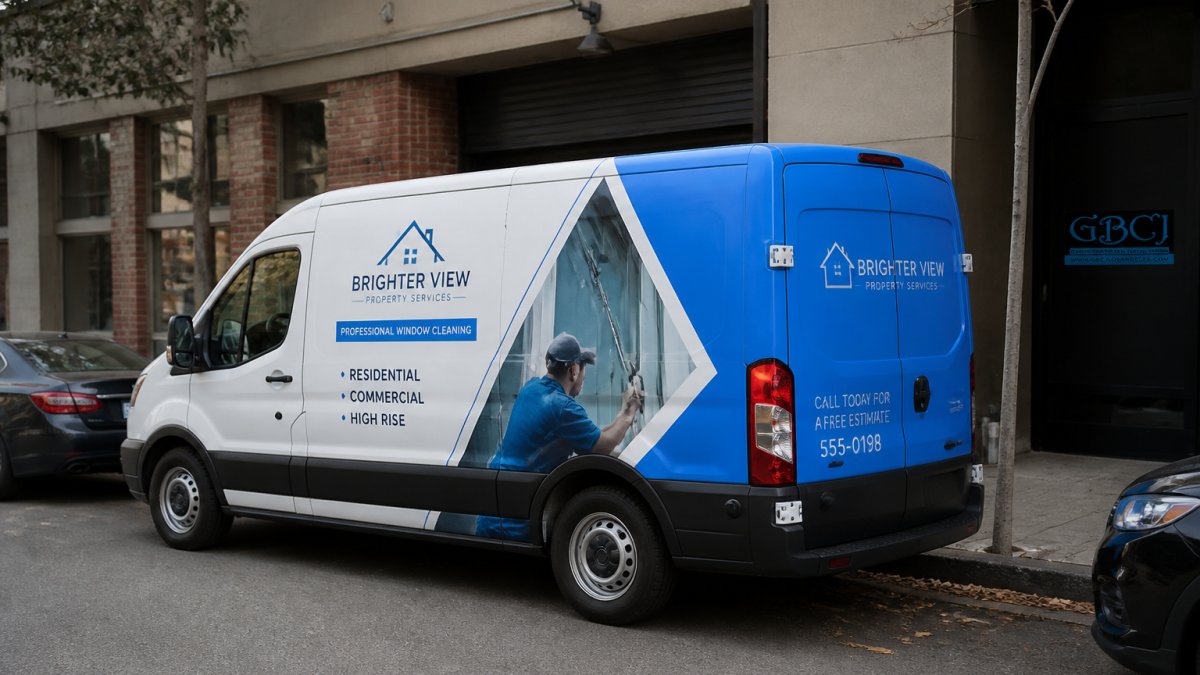
Building one brand system across mixed vehicle types
Most fleet design advice stops short here. A fleet is rarely made of identical vehicles, cargo vans, pickup trucks, box trucks, and sedans.
Use a modular design system instead of a single fixed layout:
- A fixed brand block. Logo, primary color, and typeface stay identical on every vehicle, the anchor that makes the fleet recognizable.
- A flexible message zone. The service line and contact block scale and reposition to fit each vehicle's available panel: the long side panel on a van, doors and bed sides on a pickup, rear quarter and trunk on a sedan.
- A consistent color palette. Keep the same two or three colors across the fleet so a van and a box truck read as the same company even when layouts differ.
To test the system, shrink every vehicle's design to a thumbnail and line them up. If they look like one family, it works. If each looks like a different company, the brand block isn't doing its job.
Match the design to how each vehicle works
Consider your fleet's operating environment. Job-site vehicles benefit from a design emphasizing your service category and phone number; residential-neighborhood vehicles from consistent logo placement that builds recognition; delivery fleets from a design highlighting reliability and professionalism.
Design the system once, then adapt it per vehicle type rather than designing each vehicle from scratch. A shared brand block plus a flexible message zone keeps the fleet consistent, cuts design time on every additional vehicle, and makes it far easier to add a new vehicle to the fleet later without a redesign.
The best approach is to work with a designer who understands vehicle wraps and has experience with fleet applications. We also offer Custom Business Signs and Vinyl Graphics services that complement vehicle wraps and extend your brand consistency across all customer touchpoints, from your storefront to your fleet to your office lobby.
Vehicle Wrap Durability and Maintenance Best Practices
A properly installed partial vehicle wrap typically lasts five to seven years under normal operating conditions, depending on material quality, installation technique, and ongoing maintenance.
High-quality vinyl resists fading, cracking, and peeling better than budget alternatives, and professional installation ensures proper adhesion and sealed seams against moisture.
Clean your wrapped vehicle every two weeks with mild soap, water, and a soft cloth.
Minor scratches or gouges don't require full wrap replacement, many providers patch small damaged sections.
Store wrapped vehicles in covered parking when possible. UV exposure is the primary cause of vinyl fading. A vehicle garaged overnight and used during business hours will maintain color vibrancy significantly longer than one parked outdoors continuously. If covered parking isn't available, consider a quality car cover for vehicles not in active use.
Paint Protection and Non-Permanent Branding
One significant advantage of partial vehicle wraps fleets gain is paint protection: the vinyl acts as a barrier against minor scratches, UV damage, and environmental contaminants.
This non-permanent approach gives you branding flexibility. If your company rebrands or pivots its services, you can remove the wrap and apply a new design without repainting, particularly valuable for growing businesses that evolve their messaging over time.
Fleet managers appreciate this flexibility because it reduces long-term commitment: you're applying a temporary but durable branding layer, not permanently altering your vehicles.
Getting Started: Design, Installation, and Timeline
Start by defining your goals: one vehicle to test the concept, or multiple as part of a broader fleet branding initiative?
Share your brand guidelines, logo files, and any existing marketing materials with your wrap provider.
Once the design is approved and your quote finalized, installation is scheduled.
After installation, the wrap needs 24-48 hours to fully cure before heavy use.
Working with an experienced provider like GBCJ Los Angeles simplifies the process.
Partial vehicle wraps for fleets represent a practical balance between brand visibility and operational budget constraints. Contact GBCJ Los Angeles to discuss your fleet's branding needs and get a customized quote for partial vehicle wrap design and installation.
Frequently Asked Questions
What are the main benefits of partial vehicle wraps for fleets?
Partial vehicle wraps deliver mobile advertising that reaches thousands of potential customers daily as your fleet operates. They protect original paint from weather damage and minor scratches, preserve resale value, and cost significantly less than full wraps. For businesses managing multiple vehicles, partial wraps offer design flexibility and brand consistency without the expense of wrapping entire fleets. They're also easier to update or remove when your branding changes, making them a practical investment for growing companies.
How much more affordable is a partial wrap compared to a full vehicle wrap?
Partial wraps typically cost 40-60% less than full wraps because they cover fewer vehicle surfaces, usually side panels, rear sections, or specific zones rather than the entire exterior. The exact savings depend on your vehicle size, coverage area, design complexity, and local installation costs. For fleet operations with multiple vehicles, these cost differences multiply quickly. Contact a local fabrication partner for a detailed quote based on your specific fleet size and coverage needs.
How long do partial vehicle wraps last, and what maintenance do they need?
Quality vinyl wraps typically last 5-7 years with proper care. Durability depends on climate exposure, vehicle usage, and maintenance habits. Wash wrapped areas regularly with mild soap and water, avoid high-pressure washers near edges, and park in shade when possible to extend color vibrancy. Professional installation ensures edges seal properly, preventing peeling. If damage occurs, minor scratches, small tears, spot repairs are possible without replacing the entire wrap. Choose a fabrication partner who offers warranty coverage and clear maintenance guidance.
Can I customize partial wraps differently across my fleet vehicles?
Yes. Partial wraps allow you to maintain core brand elements (logo, color scheme, contact info) while adjusting coverage areas and messaging for different vehicle types. A service truck might feature your phone number prominently on the side, while a delivery van emphasizes your website. This flexibility lets you optimize each vehicle's advertising based on its role and visibility patterns. Custom design ensures brand consistency across your fleet while maximizing the impact of each vehicle's unique placement on job sites and routes.