 ultimate-guide
Vehicle Wrap Cost Estimation Guide for 2026
Table of Contents
- What Drives Vehicle Wrap Cost: A Practical Breakdown
- Factors Affecting Car Wrap Price You Should Know
- Full vs Partial Vehicle Wrap Cost: Which Fits Your Budget?
- Best Vinyl Wrap Brands for Longevity and Value
- Hidden Costs: Removal, Prep, and Warranty Implications
- How to Get an Accurate Vehicle Wrap Cost Estimation
- Step 1: Document the Vehicle Honestly
- Step 2: Decide Coverage, Finish, and Film Grade Before You Ask for a Price
- Step 3: Ask About Removal and Prep, Explicitly
- Step 4: Understand Regional Labor Variance
- Step 5: Confirm Warranty and Insurance Treatment
- Step 6: Request an Itemized Quote and Compare Line by Line
- Step 7: For Fleets, Ask About Volume and Scheduling
- Frequently Asked Questions
Last Updated: September 22, 2026
What Drives Vehicle Wrap Cost: A Practical Breakdown
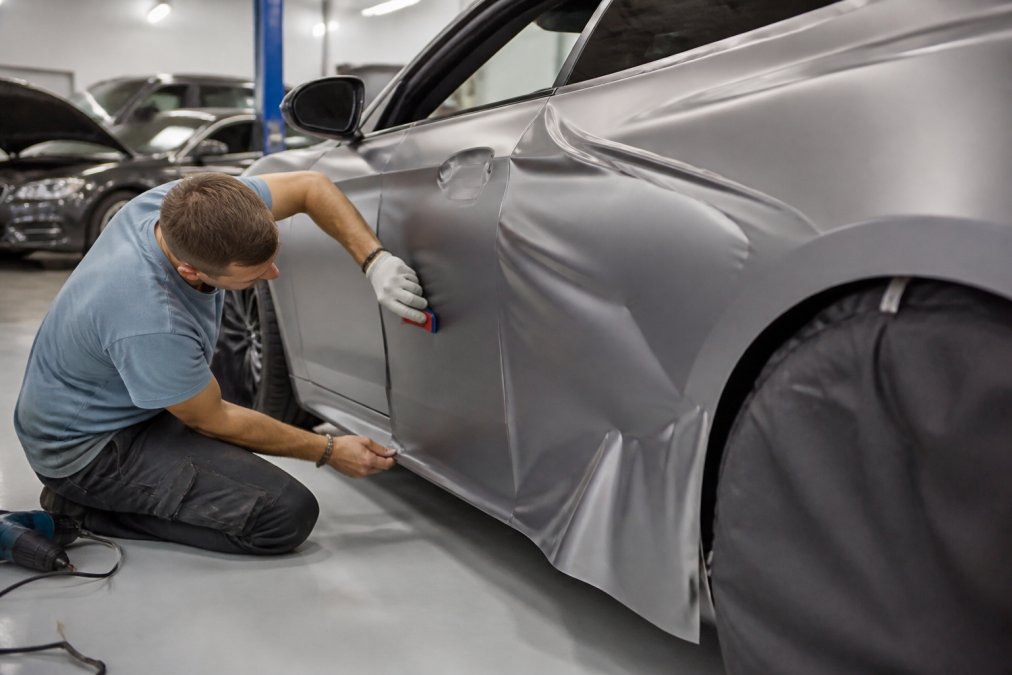
Vehicle wrap cost estimation is the process of calculating what it will take to cover a vehicle in vinyl film, factoring in material, labor, vehicle size, and prep work. Most quotes land where they do because of five variables: square footage, film grade, installation complexity, surface condition, and whether you need a full or partial coverage.
How Estimators Build a Quote
A wrap quote is built from four line items: material, labor, prep, and design. Material scales with surface area. Labor scales with complexity and install time. Prep scales with how much correction the paint needs before film touches it. Design is either a flat fee or bundled into the project.
Factors Affecting Car Wrap Price You Should Know
The factors affecting car wrap price break into two buckets: physical (how big and how curvy the vehicle is) and material (what film you choose). Both move the number more than most buyers expect.
Vehicle Size and Surface Area
A compact sedan needs far less vinyl than a full-size pickup or a cargo van. Surface area drives material cost directly, and larger panels also take longer to install, which pushes labor up. Vehicles with complex curves, deep recesses, or lots of trim take more time to wrap cleanly than a boxy shape with flat panels.
Material Grade and Finish Type
Film grade and finish change both cost and lifespan. Economy calendered vinyl costs less upfront but tends to shrink and lift sooner. Premium cast vinyl conforms to curves, resists UV fading, and holds up longer. Finish matters too: gloss, matte, and satin each behave differently during install, and specialty finishes like color-shift or textured films cost more because they're harder to source and apply.
| Factor | What It Changes | Why It Matters |
|---|---|---|
| Vehicle size | Material volume, install hours | Bigger surface area means more film and time |
| Panel complexity | Labor hours | Curves and recesses slow installation |
| Film grade | Material cost, lifespan | Cast vinyl outlasts calendered |
| Finish type | Material cost, install difficulty | Specialty finishes cost more to apply |
| Paint condition | Prep cost | Rough or peeling paint needs correction first |
Full vs Partial Vehicle Wrap Cost: Which Fits Your Budget?
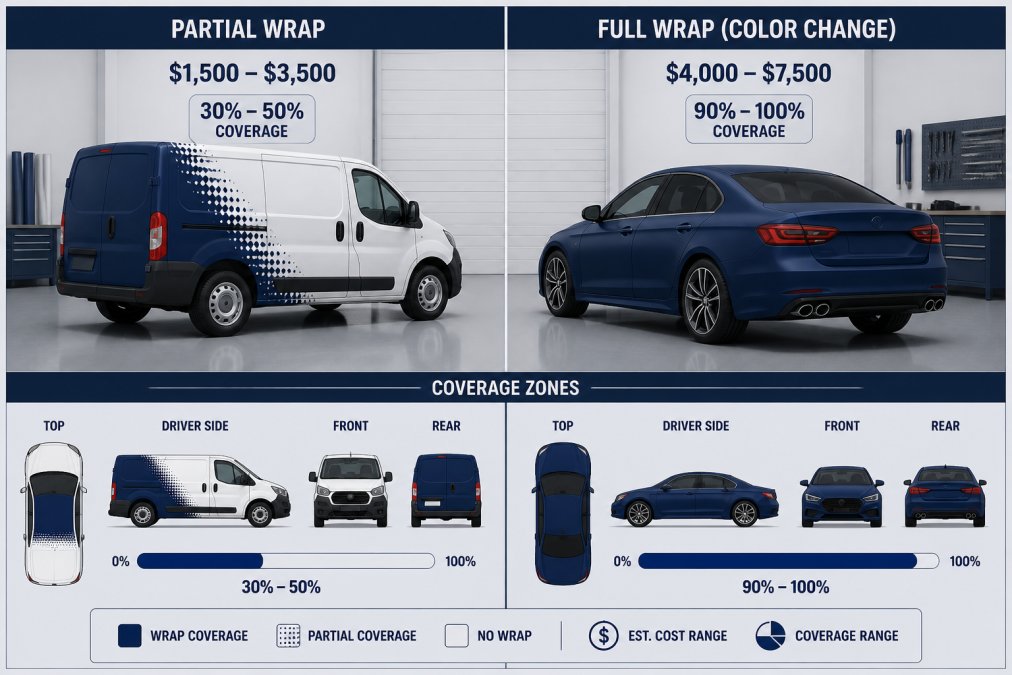
The full vs partial vehicle wrap cost gap is not a fixed percentage, it tracks square footage, panel count, and install hours. As a working rule, a full wrap covers 100% of painted exterior body panels, a partial wrap typically covers 25% to 60% of the vehicle (doors, hood, rear, or rocker panels), and a half wrap sits in the middle by covering the sides and rear but leaving the hood, roof, and front bumper in paint.
What Each Coverage Level Actually Includes
| Coverage Level | Panels Covered | Typical Share of Vehicle Surface | What It's Best For |
|---|---|---|---|
| Partial (spot) | Doors + rear, or hood + roof only | 25%-40% | Budget branding, single-message fleet units |
| Half wrap | Sides + rear, paint left on hood/roof/front | 50%-60% | Service vans, trucks with cab-forward designs |
| Full wrap (commercial) | All exterior painted panels, no jambs | ~90%-95% | Maximum brand exposure, fleet consistency |
| Full color change | All exterior panels plus door jambs, sometimes interior edges | 100% | Color change, resale, premium builds |
How Vehicle Class Shifts the Number
Surface area is the reason two 'full wraps' can differ by thousands of dollars. A compact sedan, a mid-size SUV, a full-size pickup, and a cargo van are not interchangeable quotes. As a general pattern shops use when estimating:
- Compact sedan / coupe, smallest film footprint, fewest complex panels, lowest labor hours.
- Mid-size SUV / crossover, more roof and rear glass trim, moderate complexity.
- Full-size pickup, large flat bed panels are fast, but the cab, mirrors, and wheel arches add hours.
- Cargo van / Sprinter, largest surface area, tall vertical panels, and roof access that often requires a lift or scaffolding, which adds labor.
The Hidden Multiplier: Door Jambs and Edges
A commercial full wrap usually stops at the panel edge. A color-change full wrap often includes door jambs, hood and trunk edges, and sometimes interior door frames so no original paint shows when doors open. Those areas are slow, awkward to reach, and require disassembly and reassembly of trim, handles, and lights.
Best Vinyl Wrap Brands for Longevity and Value
Film brand matters less than film type, but reputable manufacturers back their products with warranties that protect your investment. The best vinyl wrap brands for longevity focus on cast films with UV-resistant laminates, since those hold color and resist peeling longer than budget alternatives.
Cast vs Calendered Vinyl
Cast vinyl is manufactured by pouring liquid vinyl onto a casting sheet, which produces a thinner, more conformable film. Calendered vinyl is pressed between rollers, making it thicker and less flexible. Cast film costs more but conforms to complex curves and resists shrinking, which is why shops recommend it for full wraps and long-term installs.
Hidden Costs: Removal, Prep, and Warranty Implications
Removal and prep are the two costs buyers forget to ask about, and both can change your final number significantly. Old vinyl has to come off before new film goes on, and that removal takes labor. Paint correction adds more if the surface underneath is rough, faded, or peeling.
Skipping paint correction to save money upfront often voids the film warranty. If the surface isn't clean and smooth, the adhesive can't bond properly, and the wrap may peel within months.
How to Get an Accurate Vehicle Wrap Cost Estimation
An accurate vehicle wrap cost estimation starts before you call a shop. The quote you receive is only as good as the inputs you give, and the inputs most buyers forget are the ones that move the number the most: existing vinyl, paint condition, and where you are located.
Step 1: Document the Vehicle Honestly
Measure the vehicle and photograph all four sides, the roof, and any damage. Note peeling clear coat, dents, rust, prior repaints, and any existing vinyl or decals. A shop quoting from photos will price to what it sees, if you hide the peeling roof, the quote will change once the vehicle is on the lift, and that change is rarely in your favor.
Step 2: Decide Coverage, Finish, and Film Grade Before You Ask for a Price
Coverage level (partial, half, full, color change), finish (gloss, matte, satin, specialty), and film grade (calendered vs. cast) are the three choices that determine the bulk of the cost. Lock them in first. A shop cannot give you a comparable number if you are still deciding between a matte partial and a gloss full wrap.
Step 3: Ask About Removal and Prep, Explicitly
This is the step most guides skip. If the vehicle has old vinyl, removal is a separate labor line, and it is not trivial: adhesive residue, baked-on film, and brittle edges all add hours. If the paint underneath is rough, faded, or peeling, paint correction or a primer layer may be required before new film goes down. Ask three specific questions:
- Is removal of existing vinyl included, or quoted separately?
- What is the prep scope, wipe-down only, or full paint correction?
- If the paint fails under the film, what does the warranty say?
Step 4: Understand Regional Labor Variance
Labor rates are not national. Urban shops in high-cost metros charge more per hour than rural shops, and the same film and same vehicle can produce quotes that differ by a wide margin purely on geography. This is not a markup, it reflects rent, insurance, and technician wages. When you compare two quotes from different regions, compare the labor hours and the hourly rate separately, not just the bottom line.
Step 5: Confirm Warranty and Insurance Treatment
Film warranties are typically manufacturer-backed and cover defects like bubbling, lifting, and premature fading, but they usually exclude damage from poor prep, pressure washing, or abrasive cleaning. Ask for the warranty in writing and confirm who honors it: the film maker, the installer, or both. Separately, confirm with your insurer how a wrap is treated.
Step 6: Request an Itemized Quote and Compare Line by Line
Ask for material, labor, prep, removal, and design broken out separately. Two quotes with the same total can hide very different scopes, one may include removal and prep, the other may not. Itemization is the only way to compare bids fairly.
A quote that is dramatically lower than the others is almost always missing a line, usually removal, prep, or door jambs. Ask what is excluded, not just what is included.
Step 7: For Fleets, Ask About Volume and Scheduling
For fleet branding or multi-vehicle commercial projects, ask whether the shop offers volume pricing and whether vehicles can be wrapped in batches to reduce setup time. Batch scheduling often lowers per-vehicle labor because the shop is not re-measuring and re-setting up for each unit.
Frequently Asked Questions
What is the average cost range for a full vehicle wrap?
A full vehicle wrap cost depends on vehicle size, material grade, design complexity, and labor rates in your area. A compact car with a basic color change wrap sits at the lower end, while a full-size van or truck with custom graphics and premium cast vinyl lands at the higher end. Requesting itemized quotes from three local shops gives you the most accurate picture for your specific vehicle and finish.
Does the type of vinyl material affect the cost of a vehicle wrap?
Yes. Cast vinyl costs more than calendered vinyl because it conforms to curves and recesses without lifting, which matters for long-term durability and warranty coverage. Premium brands with UV-resistant laminate add to the material line item but reduce fading and peeling. Ask your installer which material grade they use and whether the quote includes a laminated top layer.
How does vehicle size impact custom wrap pricing?
Surface area is one of the biggest cost drivers. A coupe has far less square footage than a cargo van, so it needs less vinyl, fewer labor hours, and often a simpler installation. Larger vehicles also require more prep work and may need two installers. Always share your exact make, model, and year when requesting a quote so the estimator can calculate accurate square footage.
Are there additional costs for custom design and installation?
Most quotes separate graphic design fees from installation labor. If you already have print-ready artwork, you may avoid design charges. Complex custom graphics, fleet branding with matching layouts across multiple vehicles, and specialty finishes like matte or satin add to both design and install time. Ask for a line-item breakdown so you can see exactly where the money goes.