 ultimate-guide
Office Interior Signage: Impact on Brand & Business
Table of Contents
- How Office Interior Signage Shapes First Impressions and Brand Identity
- ADA Compliance for Office Signs: Legal Requirements and Best Practices
- Office Wayfinding Design Best Practices for Navigation and Accessibility
- Benefits of Custom Reception Signage for Client Experience
- The Business Impact: ROI and Measurable Benefits of Quality Office Signage
- Material Selection and Sustainability in Professional Office Signage
- Integrating Digital Signage and Environmental Graphics Into Your Office Design
- Frequently Asked Questions
Last Updated: October 4, 2026
How Office Interior Signage Shapes First Impressions and Brand Identity
The moment a client walks through your office door, they're forming opinions about your business in seconds. That split-second judgment hinges largely on what they see, and office interior signage plays a central role in shaping that first impression. Quality signage communicates professionalism, attention to detail, and brand consistency before a single word is spoken.
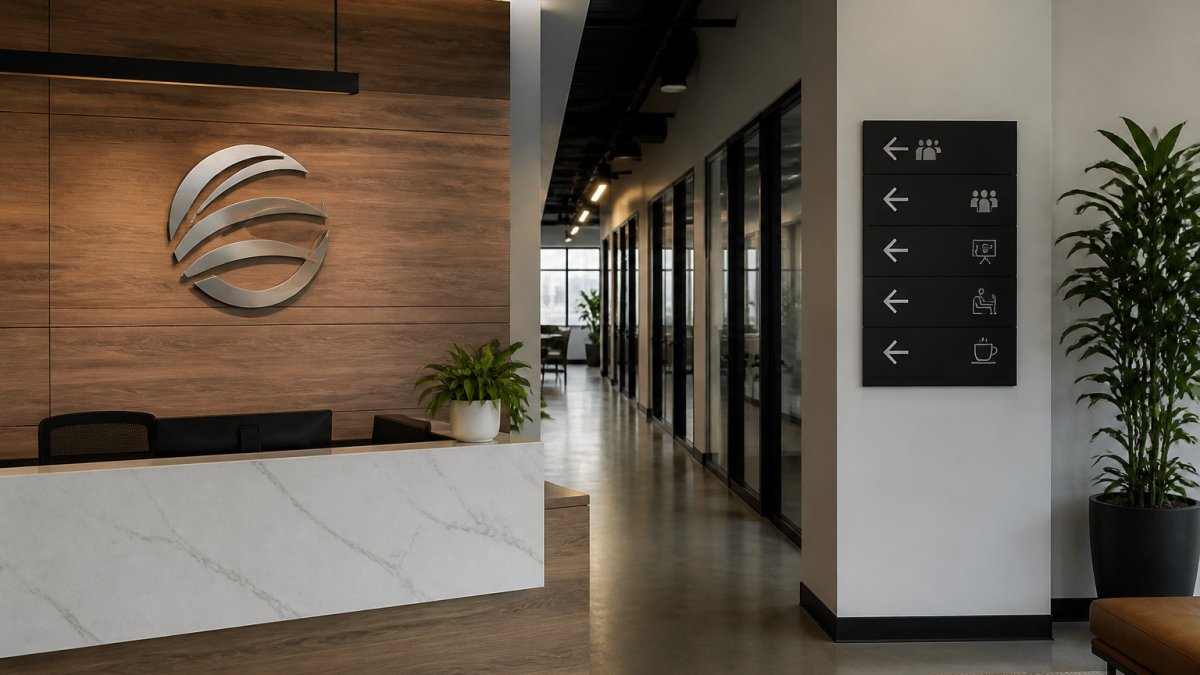
Office interior signage is a strategic business tool that reinforces brand identity. Cohesive color schemes, clear typography, and consistent messaging signal intentionality and trustworthiness, while poor signage suggests corner-cutting and indifference to detail.
Custom office interior signage transforms client perceptions. Properly branded reception signage featuring your company name, mission statement, or core values creates immediate belonging, while environmental graphics guide visitors intuitively and reinforce organizational culture.
Office interior signage communicates your values, market position, and attention to quality. When reception signage aligns with storefront branding, vehicle graphics, and digital presence, you create unified brand experience that builds trust and memorability.
ADA Compliance for Office Signs: Legal Requirements and Best Practices
ADA-compliant office interior signage is a legal requirement that protects your business from liability while ensuring all visitors can navigate safely and independently.
ADA-compliant office interior signage requires raised characters and Braille for permanent room identification, with characters between 5/8 and 2 inches tall and 70 percent contrast ratio between characters and background. These are enforceable standards.
According to ADA Accessibility Guidelines for Buildings and Facilities, visual contrast and legibility are essential for wayfinding signage. Your office interior signage must be positioned at a consistent height, typically 48 to 60 inches from the floor to the center of the sign, so that wheelchair users and people of varying heights can read it comfortably. Mounting height matters as much as content.
Ensure office interior signage is well-lit and free from glare to meet ADA compliance and support readability for people with low vision.
Office Wayfinding Design Best Practices for Navigation and Accessibility
Effective office wayfinding design guides visitors intuitively through your space, reducing confusion and improving client experience through cohesive visual communication including floor markings, room identification, and emergency exits.
Best office wayfinding design anticipates visitor questions through clear directional signage at key decision points. Consistent color coding, iconography, and typography make the system predictable and easy to follow.
Research from Environmental Design Research Association shows that effective wayfinding reduces stress and improves navigation success rates in complex spaces. For office environments, this translates to better first impressions and smoother client experiences. When visitors move confidently through your space, they perceive your organization as well-organized and professional.
Office wayfinding signage must accommodate people with visual impairments, mobility challenges, and cognitive disabilities through visual elements (clear typography, high contrast, intuitive symbols), tactile cues, and Braille labels.
Benefits of Custom Reception Signage for Client Experience
Custom reception signage immediately communicates that clients have arrived at a legitimate, organized business and sets expectations for service quality.
Custom reception signage displays your company name and logo, reinforces brand identity, communicates mission or values, and includes wayfinding information, when integrated cohesively, the impact is significant.
Visitors form judgments within the first 7 seconds of entering your office. Reception signage is the focal point, high-quality materials, professional design, and thoughtful placement signal competence and trustworthiness, while poor signage undermines confidence.
Clear office interior signage identifying meeting areas, restrooms, and emergency exits improves operational efficiency by reducing staff time on directional questions.
The Business Impact: ROI and Measurable Benefits of Quality Office Signage
Quality office interior signage delivers measurable business outcomes that extend beyond aesthetics. While signage ROI isn't tracked as a standalone metric by most organizations, the underlying mechanisms, client perception, brand recall, operational efficiency, and compliance risk reduction, are well-documented and quantifiable.
Client Perception and Conversion Impact
Professional, cohesive visual environments increase perceived trustworthiness and competence. Studies show improved environmental design correlates with 10-15 percent increases in client satisfaction scores, predicting repeat business and referrals.
Operational Efficiency and Labor Cost Reduction
Clear office wayfinding signage reduces staff time on directional questions. In a mid-sized office, this can save $10,400-$32,500 annually in productivity loss. Professional wayfinding systems cost $3,000-$10,000 to install, with payback often under one year.
Compliance Risk and Legal Cost Avoidance
ADA non-compliance can result in settlements of $5,000-$50,000 per case plus mandatory remediation costs. A comprehensive ADA-compliant signage audit and retrofit for a 10,000-20,000 square foot office costs $8,000-$20,000, far less than litigation and remediation.
Brand Recall and Market Positioning
Consistent, professional office signage reinforces brand identity and improves recall. Clients who experience cohesive visual branding are more likely to remember and recommend your organization, particularly in competitive markets.
Measuring Signage ROI in Your Organization
To quantify the impact of office interior signage in your specific context, track these metrics before and after implementation:
- Client satisfaction scores: Survey clients on their office experience and navigation ease before and after signage installation.
- Staff time on wayfinding: Log the time staff spend answering directional questions or orienting visitors for a baseline period, then measure again after signage is installed.
- Compliance audit results: Document any ADA violations identified in a pre-installation audit, then verify remediation post-installation.
- Client retention and referral rates: Monitor whether clients who experience improved office environments show higher retention and referral rates compared to baseline.
- Visitor feedback: Include a simple question in client feedback surveys about office professionalism and navigation ease.
Material Selection and Sustainability in Professional Office Signage
Material selection for office interior signage affects durability, appearance, maintenance, and environmental impact. Professional-grade materials communicate quality and longevity.
Common materials for office interior signage include aluminum (durable, modern), acrylic (flexible, backlit options), wood (warm, traditional), and vinyl (versatile, cost-effective).
Durable, recyclable, or sustainably sourced materials reflect organizational values and appeal to environmentally conscious clients while reducing long-term replacement costs and waste.
The material you select should align with your office design aesthetic and your brand positioning. A tech startup might choose sleek aluminum and acrylic, while a law firm might opt for wood and brass. The key is selecting materials that reinforce your brand identity while delivering the durability and functionality your office environment requires.
Integrating Digital Signage and Environmental Graphics Into Your Office Design
Modern office environments increasingly blend traditional static signage with digital displays and environmental graphics. This integration creates dynamic, flexible communication systems that can be updated in real time while maintaining visual cohesion.
The Psychology of Digital vs. Static Signage
Digital displays capture attention through movement and changing content, making them effective for announcements and real-time information. However, overuse creates visual clutter. Balance dynamic digital elements with calm, static signage for stable wayfinding and core brand identity.
Static signage works best for permanent wayfinding and core brand messaging. Integrate both: static signage for foundational elements, digital displays for time-sensitive information.
Strategic Placement and Content Strategy
Digital signage works best in high-traffic areas (lobbies, elevator banks) and for meeting room availability displays. Real-time announcements and event information keep your office current without physical replacement.
Digital displays showing outdated information or malfunctioning damage professional image. Establish a content calendar, assign ownership for updates, and budget 2-4 hours weekly for content management.
Environmental Graphics and Immersive Brand Experience
Environmental graphics, large-scale visual elements that transform office walls and spaces, create immersive brand experiences that reinforce organizational culture and values.
According to the Society for Experiential Graphic Design, the most effective environmental graphics integrate seamlessly with architecture and interior design while supporting clear communication objectives.
Environmental graphics also influence employee perception and workplace culture. Employees who work in spaces with thoughtfully designed environmental graphics report higher engagement and stronger connection to organizational values.
Integration Best Practices
When combining digital signage, environmental graphics, and traditional static signage, follow these principles:
- Visual hierarchy: Establish clear visual priority. Core wayfinding and brand identity should be static and stable. Digital elements should supplement, not compete with, foundational signage.
- Consistent design language: All signage elements, static, digital, and environmental, should share a cohesive design language in terms of color palette, typography, and visual style. Inconsistent design undermines the unified brand experience.
- Functional separation: Use digital signage for information that changes frequently (meeting room availability, real-time announcements). Use static signage for permanent information (room identification, core wayfinding). Use environmental graphics for brand identity and cultural messaging.
- Maintenance planning: Digital signage requires ongoing technical support and content management. Budget for this before implementation. A neglected digital display is worse than no display.
- Accessibility: Ensure all signage, static, digital, and environmental, meets ADA requirements. Digital displays should have sufficient contrast, readable font sizes, and alternative text for any images or graphics.
Measuring the Impact of Integrated Signage Systems
Track these metrics to evaluate the effectiveness of your integrated signage approach:
- Visitor navigation success: Monitor whether visitors reach their destinations without asking for directions.
- Employee engagement with environmental graphics: Survey employees on whether they notice and connect with environmental messaging.
- Digital display engagement: Track how often digital displays are viewed and whether content updates generate interest or engagement.
- Maintenance and technical issues: Log any downtime or technical problems with digital displays to assess reliability and support requirements.
- Overall office perception: Include questions about office professionalism, visual cohesion, and brand clarity in client and employee feedback surveys.
Frequently Asked Questions
What are the ADA requirements for office interior signage?
The Americans with Disabilities Act requires office signage to meet specific standards for accessibility. Signs must include Braille and raised characters for permanent room identification, maintain proper contrast ratios between text and background, use sans-serif fonts at appropriate sizes, and be positioned at accessible heights and locations. Directional and informational signs must also follow color and contrast guidelines. Compliance ensures all employees and visitors, regardless of visual ability, can navigate your office effectively and safely.
How does office interior signage impact employee morale and workplace culture?
Quality office signage reinforces your organizational culture and mission statement through consistent visual communication. When employees see clear branding, motivational messages, and well-designed directional elements, it strengthens their connection to company values and creates a more professional workplace environment. Thoughtful signage design also reduces confusion about navigation and processes, which improves employee productivity and satisfaction. A cohesive visual identity signals that leadership invests in workplace quality, directly affecting morale and retention.
What materials work best for high-quality office interior signage?
Durable materials like brushed aluminum, acrylic, wood, and composite panels are ideal for office signage because they resist wear and maintain appearance over time. Your choice depends on your office aesthetics, budget, and durability requirements. Aluminum and acrylic offer modern looks and excellent longevity, while wood provides warmth and sophistication. Sustainable options like recycled materials are increasingly popular for companies prioritizing environmental responsibility. A professional signage partner can recommend materials that match your interior design, withstand daily traffic, and align with your brand identity.
How does professional office signage improve the visitor experience?
Professional signage eliminates confusion and creates a seamless navigation experience for clients and guests. Clear wayfinding directs visitors to the right departments without asking for directions, reducing friction and improving their perception of your organization's competence. Custom reception signage makes an immediate positive impression, reinforcing brand identity and professionalism. When visitors move through your office with confidence, they experience your brand more positively, which strengthens client relationships and supports your business reputation.