 listicle
Why Cheap Signage Costs More Long Term: 2026 Guide
Table of Contents
- The Real Math Behind Cheap Signage: Upfront Savings vs. Total Cost of Ownership
- What Cheap Signage Actually Costs: 7 Hidden Expenses That Add Up
- Average Cost of Storefront Signage: What Budget vs. Durable Options Really Run
- How Cheap Signs Damage Brand Perception and Customer Trust
- Signage Maintenance Best Practices That Extend Lifespan and Cut Repeat Expenses
- ROI of High-Quality Business Signs: A Cost-Benefit Analysis
- The Costs Competitors Ignore: Compliance, Energy, and Insurance
- Conclusion
- Frequently Asked Questions
Last Updated: September 11, 2026
The Real Math Behind Cheap Signage: Upfront Savings vs. Total Cost of Ownership
A cheap sign looks like a bargain on the invoice, rarely two years later. Why cheap signage costs more long term comes down to one shift in thinking: treating a sign as a capital asset with a lifespan, a maintenance schedule, and a replacement date, not a one-time purchase.
Total cost of ownership (TCO) is the full expense of a sign across its entire service life, including the purchase price, installation, maintenance, repairs, downtime, and eventual replacement. Most buyers only ever see the first line of that equation.
This guide breaks down where the hidden money goes, what budget versus durable options actually run, and how to calculate a sign's real return before you buy. The core argument: signage is asset management, not shopping.
What Cheap Signage Actually Costs: 7 Hidden Expenses That Add Up
Cheap signage costs more long term because material savings are paid back through repeat expenses: faster replacement cycles, higher maintenance, installation labor, downtime, brand damage, compliance fixes, and disposal. Together they routinely exceed the price gap between a budget sign and a durable one. Here are the seven expenses that never show up on the original quote:
- Faster material degradation from UV exposure, rain, and temperature swings
- Repeated maintenance and cleaning to keep a fading sign legible
- Replacement labor every time the sign comes down and a new one goes up
- Business downtime while the storefront sits unsigned
- Brand perception damage from a visibly worn sign
- Compliance corrections when a sign fails a permit or code inspection
- Disposal and re-fabrication costs that durable signage avoids entirely
The Hidden Costs of Cheap Materials
The materials decision sets the whole cost curve. Vinyl not rated for outdoor UV fades and cracks; thin substrates warp; low-grade adhesives lift at the edges. A sign that fails structurally doesn't just look bad, mounted overhead, it becomes a safety issue. Material failure is rarely gradual; it tends to happen right after the warranty window closes.
Frequency of Replacement Cycles
A durable sign and a cheap sign don't just differ in price, they differ in how often you pay it. If a budget sign needs replacing twice as often, the "savings" evaporate by the second replacement, and you've paid installation labor twice for the same wall. Every replacement carries its own design time, permitting, fabrication, and installation, none of which get cheaper the second time.
Average Cost of Storefront Signage: What Budget vs. Durable Options Really Run
There is no single average cost of storefront signage, price depends on size, material, illumination, mounting method, and permits. What you can compare is the cost structure: budget signs front-load savings and back-load expenses; durable signs front-load investment and reduce repeat spending. Run the numbers on a typical 4-foot-by-8-foot illuminated storefront sign:
| Cost Category | Budget Sign | Durable Sign |
|---|---|---|
| Upfront purchase (installed) | Varies | Varies |
| Material lifespan | 3-5 years | 10-15 years |
| Maintenance frequency | 1-2 service calls per year | 1 service call every 2-3 years |
| Replacement cycle | Every 3-5 years | Every 10-15 years |
| Installation labor | Repeated each cycle | Once |
| Brand presentation | Degrades quickly | Holds up |
| Long-term value | Poor | Strong |
A Five-Year Total Cost of Ownership Calculation
Here is the same comparison as a five-year TCO. Figures are illustrative, substitute your own quotes, but the structure is the point:
Budget sign, five years:
- Purchase and install: $2,000
- Annual cleaning and minor repair: $150 × 5 = $750
- One mid-cycle replacement (labor + fabrication): $2,000
- Downtime during replacement (two days of lost walk-in traffic): variable, often $500-$2,000
- Five-year total: roughly $5,250-$6,750
Durable sign, five years:
- Purchase and install: $6,000
- Annual cleaning and minor repair: $75 × 5 = $375
- No mid-cycle replacement
- Five-year total: roughly $6,375
The gap narrows to almost nothing by year five, and the durable sign still has five to ten years left, while the budget sign heads into its second replacement. Over ten years, the budget sign's TCO can run significantly higher.
What Drives the Price Gap
The upfront difference between a budget and durable sign is rarely the sign face. It's the substrate, illumination hardware, mounting system, and weatherproofing. A cheap sign saves money on the parts that fail first and cost the most to replace. Ask any fabricator for a line-item breakdown; if they can't provide one, that's a signal about what you're buying.
How Cheap Signs Damage Brand Perception and Customer Trust
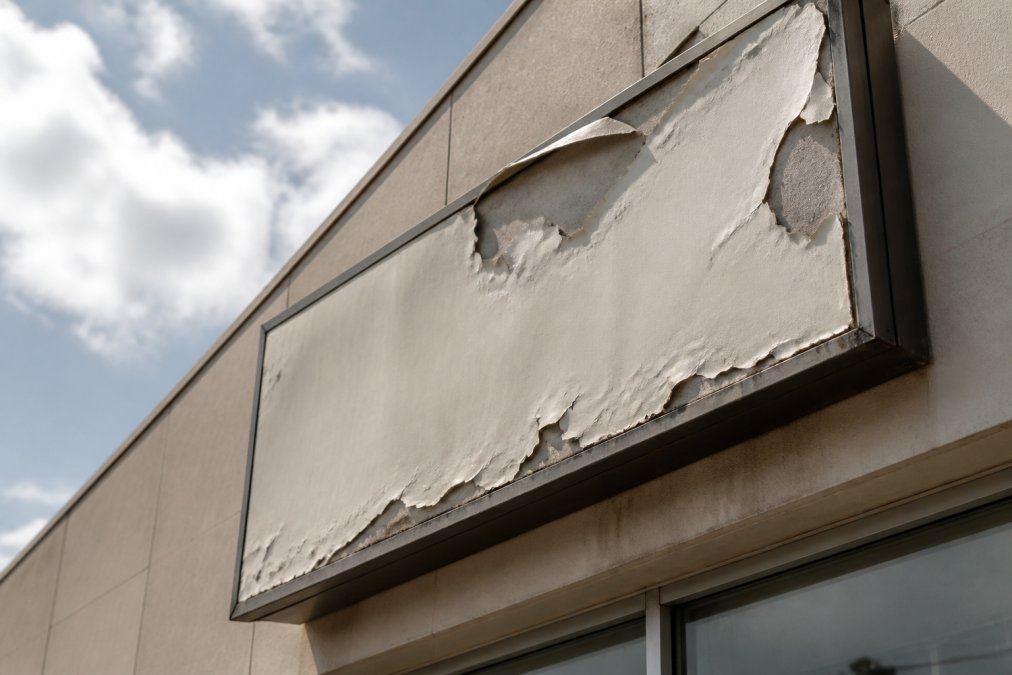
A worn sign reads as a warning to customers. Fading, peeling lettering and cracked panels signal a business that's struggling, cutting corners, or not paying attention, and that impression forms before anyone walks through the door.
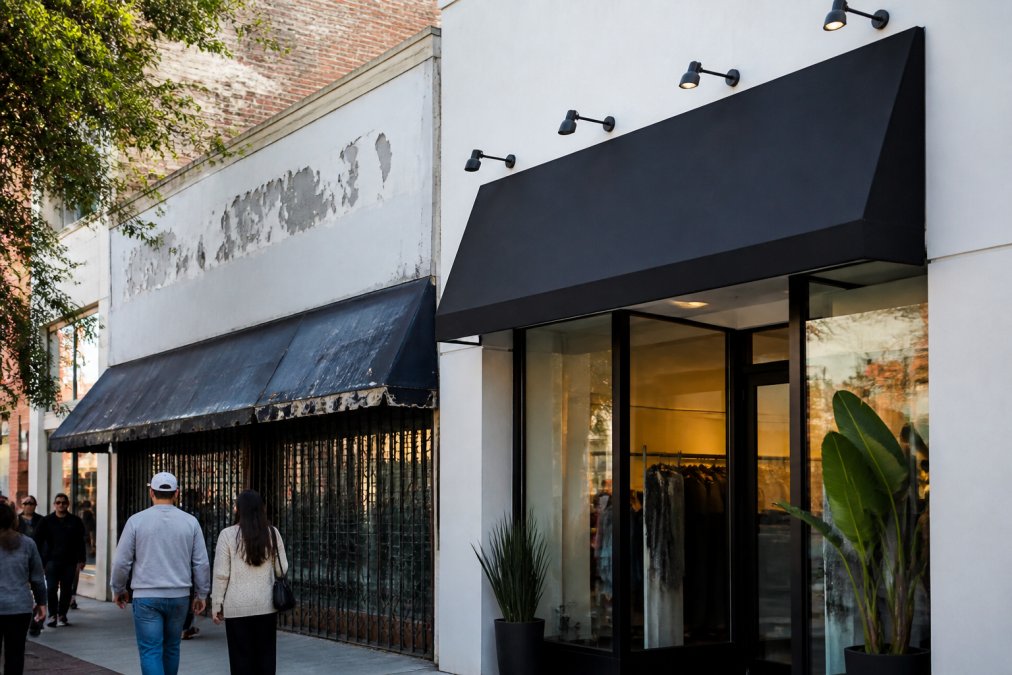
Brand equity is the commercial value a business derives from how customers perceive its name, and signage is one of the few brand assets every customer sees in person. When a sign degrades, that equity erodes with it.
Consider what a customer does with that impression: deciding whether to park, whether to walk in, whether this place will still be there next year. A visibly failing sign answers those questions for them, not in your favor. For service businesses running branded fleets, the stakes compound: a peeling wrap drives around the market advertising the problem.
Signage Maintenance Best Practices That Extend Lifespan and Cut Repeat Expenses
Signage maintenance best practices are simple, cheap, and almost universally skipped. Regular cleaning, prompt repair of small damage, and periodic inspection of mounting hardware can add years to a sign's service life. Build a routine that covers these basics:
- Wash sign faces and lettering on a regular schedule with a mild cleaner
- Inspect edges, seams, and adhesive lines for lifting or cracking
- Check mounting brackets and fasteners for corrosion or loosening
- Photograph the sign periodically to track fading against the original
- Repair small damage immediately, before water intrusion spreads it
- Log every inspection and repair for asset management records
The reason is mechanical: water behind a lifted edge accelerates adhesive failure, substrate swelling, and electrical damage in illuminated signs. A ten-minute repair now prevents a full re-fabrication later. Signs facing direct sun, coastal moisture, or heavy temperature swings need more frequent inspection than sheltered ones, adjust the cadence to the exposure, not the calendar.
ROI of High-Quality Business Signs: A Cost-Benefit Analysis
The ROI of high-quality business signs comes from two directions: lower lifetime cost and higher commercial performance. A durable sign costs less per year of service, and a well-maintained sign presents your brand at full strength the whole time it's up.
U.S. Small Business Administration guidance on business assets treats durable business property as a capital asset, which is exactly the right mental model for signage. You're not buying a product. You're acquiring an asset that depreciates, needs upkeep, and eventually gets replaced.
Run the cost-benefit analysis this way:
- Estimate the total installed cost of each option
- Estimate how many years each will realistically last
- Divide cost by years to get annual cost of ownership
- Add expected maintenance and repair costs per year
- Compare the totals, not the quotes
The option with the lower annual cost of ownership is the better buy, even when it costs more today.
The Costs Competitors Ignore: Compliance, Energy, and Insurance
Three cost categories almost never make it into a signage quote, and all three can hit hard: regulatory and compliance costs, energy efficiency, and insurance. Each is a place where cheap signage quietly transfers risk from the fabricator to you.
Regulatory and Compliance Costs
Signage is regulated locally, and the rules cover more than most owners expect: size, height, setback, illumination limits, electrical code, and in some jurisdictions, structural wind-load requirements. A cheap sign fabricated without checking those rules can fail inspection, and the failure is rarely cheap to fix.
Common outcomes when a sign does not comply:
- Permit denial or revocation, the sign cannot legally be displayed until it is rebuilt or modified.
- Code-enforcement fines, many municipalities issue daily or per-occurrence fines for unpermitted or non-compliant signage, and the meter keeps running until the sign comes down.
- Forced removal and re-fabrication, you pay twice: once for the sign that failed, once for the one that passes.
- Electrical code violations, illuminated signs must meet local electrical standards, and a cheap fixture that fails inspection can require the entire sign to be re-wired or replaced.
Before signing a fabrication contract, confirm three things with your local permitting authority: whether a permit is required, the size and illumination limits, and whether the mounting method needs structural review. A fabricator who has worked in your jurisdiction will know these answers; one who hasn't may not ask.
Energy Efficiency Metrics
Illuminated signage runs on electricity every night, and the gap between efficient and inefficient components compounds over years. Two numbers matter: wattage per square foot and rated LED lifespan.
- Wattage: A low-quality LED module or fluorescent fixture can draw two to three times the power of an efficient LED equivalent for the same brightness. On a sign that runs 12 hours a night, that difference shows up on every utility bill.
- Rated lifespan: Efficient LEDs are commonly rated for 50,000 hours or more (energy.gov). Cheap modules often fail well before that, and when they fail, the sign either goes dark or requires a service call, both of which cost money the efficient option would not have spent.
- Sealing and drivers: Water intrusion into an unsealed sign housing kills LED drivers, which are among the most expensive components to replace. A cheap housing that leaks is a recurring repair bill.
Ask for the wattage and rated lifespan of any illuminated option in writing. If the fabricator can't provide them, assume the worst and price electricity and replacement accordingly.
Insurance Implications
This is the least discussed category and potentially the most expensive. A sign that fails structurally, substandard materials, inadequate mounting, a skipped structural review, creates liability exposure if it injures someone or damages property.
Three questions to ask your insurer before installation:
- Is the sign covered under your general property policy, or does it need a separate rider? Many policies cap coverage on exterior signage, and a cheap sign that fails may not be fully reimbursed.
- Does the policy require documentation of professional installation? Some carriers will deny a claim on a sign that was installed without a licensed contractor or without a permit.
- Does a non-compliant sign affect coverage? If the sign was never permitted or violates code, an insurer may treat a resulting claim as excluded.
A cheap sign that saves $2,000 upfront but creates an uninsured liability event is the most expensive sign a business can buy. Confirm coverage in writing before the sign goes up.
Occupational Safety and Health Administration guidance on workplace safety is worth reviewing if your signage involves overhead mounting or installation work, since safe installation is part of the asset's true cost.
This is the part where cheap signage stops being a budget decision and becomes a risk decision.
Conclusion
The challenge with signage budgets: the cheap option always wins the first comparison and loses every one after it. Upfront savings are visible and immediate; wear and tear, repeat expenses, and brand damage arrive quietly over years. GBCJ Los Angeles has over 15 years of industry experience, dedicated to delivering top-notch custom signage and visual communication solutions. Our team works with you directly on storefront signs, vehicle graphics, and professional displays built to hold up, and our customer-centric approach ensures close collaboration.
Contact GBCJ Los Angeles to talk through your project and get a quote built around long-term value, not the lowest upfront number.
Frequently Asked Questions
How much does signage usually cost?
Pricing depends on size, materials, installation complexity, and whether permits are required. A small interior sign costs far less than a large illuminated storefront sign. Cheap signage often starts lower upfront but typically needs replacement within a shorter timeframe, while quality signs can last longer. For a project-specific quote, contact GBCJ Los Angeles directly.
What are the most common maintenance issues with low-quality signs?
Budget signs commonly suffer from fading due to UV exposure, peeling vinyl, cracked acrylic, rusted frames, and failing electrical components in illuminated signs. Each repair adds to your total cost of ownership. Signs made with quality materials and proper weather resistance need fewer repairs and hold their appearance longer, reducing repeat expenses over the life of the sign.
What is the typical lifespan of high-quality vs. budget storefront signage?
Budget storefront signs often have a shorter lifespan before fading, warping, or structural failure forces replacement. High-quality signs made with durable materials and professional installation typically last longer with basic signage maintenance. That difference means a cheap sign may need to be purchased multiple times before a quality sign needs its first replacement.
Are there hidden costs associated with cheap sign installation?
Yes. Cheap installation can lead to structural integrity problems, water damage behind the sign, electrical issues, and failed inspections. If the sign was installed without proper permits, you may face fines and removal costs. Correcting poor installation often costs more than the original installation would have. Professional installation protects your investment and ensures compliance with local codes.