 ultimate-guide
Vehicle Fleet Branding for Local Companies in 2026
Table of Contents
- Why Fleet Branding Works for Local Companies
- Full Wraps, Partial Wraps, and Decals: Which Fits Your Fleet
- Best Vehicle Wrap Materials for Long Term Durability
- Fleet Branding Design Best Practices
- Commercial Vehicle Wrap Cost: What Drives the Price
- Permits, Compliance, and Insurance for Branded Fleets
- DIY vs. Professional Installation: What Fleet Managers Should Know
- Keeping Wraps Looking New: Maintenance and Longevity
- Frequently Asked Questions
Last Updated: September 12, 2026
Why Fleet Branding Works for Local Companies
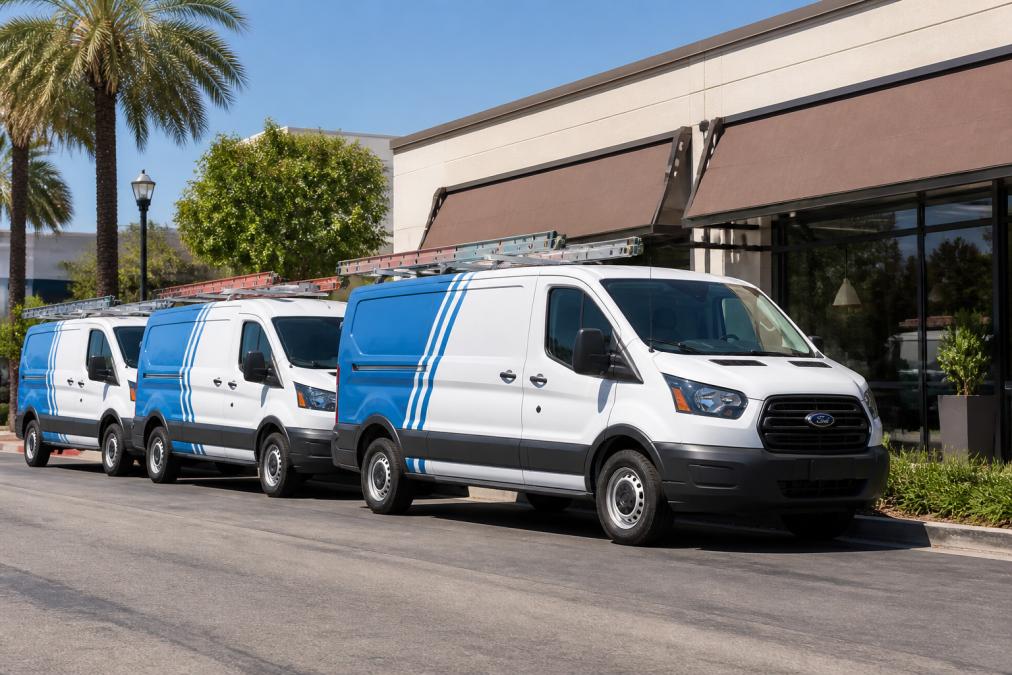
Vehicle fleet branding for local companies turns every service call into a moving advertisement. At GBCJ Los Angeles, we've watched small operators compete against national chains with bigger budgets and still win the neighborhood, because a branded van parked at a job site shows up where customers already live and work.
The math behind mobile advertising is straightforward. A single commercial vehicle drives past thousands of people every day, and each sighting compounds over months and years. Fleet graphics work because they're cumulative: one truck won't transform a business, but ten matching trucks seen weekly on the same streets build recognition that feels like familiarity, and familiarity is what makes a homeowner call the name they've already seen three times.
The Local Math Behind Mobile Advertising
Advertising impressions from a wrapped vehicle cost far less per view than most paid channels, because you pay once and the vehicle keeps working for years. A plumbing van driving 200 miles a week through residential neighborhoods is a rolling billboard with no monthly media fee.
That efficiency matters most for service businesses competing inside a defined service area: repetition inside a tight geography beats broad reach every time.
Full Wraps, Partial Wraps, and Decals: Which Fits Your Fleet
Full wraps cover the entire vehicle and deliver the strongest visual identity, but they aren't right for every fleet. Partial wraps and custom decals cost less, install faster, and still carry your logo, colors, and phone number where drivers and pedestrians will see them.
Here's how the three options compare:
| Format | Coverage | Best For | Trade-Off |
|---|---|---|---|
| Full wrap | Entire vehicle | Maximum brand visibility | Highest upfront cost |
| Partial wrap | Doors, rear, sides | Budget-conscious fleets | Less color coverage |
| Custom decals | Logo and contact info only | Small fleets, leased vehicles | Minimal design impact |
For one or two vehicles, a partial wrap plus well-placed decals often makes more sense than a full wrap. For ten identical vans, full wraps create the uniformity that makes a brand feel established.
Best Vehicle Wrap Materials for Long Term Durability
The best vehicle wrap materials for long term durability are cast vinyl films paired with a quality laminate. Material choice determines whether your fleet graphics look sharp in year five or start peeling in year two.
Cast Vinyl vs. Calendared Vinyl
Cast vinyl is poured onto a casting sheet, letting the film conform to curves and recesses without springing back. It's thinner, more flexible, and the standard choice for full wraps and complex contours.
Calendared vinyl is pressed between rollers, making it thicker and cheaper. It works on flat surfaces and simple partial wraps, but struggles on deep curves and tends to shrink over time.
Laminates and Warranties
A laminate layer protects the printed graphic from UV fading, road grit, and car wash brushes; without it, even premium vinyl fades within a couple of years. Most manufacturers tie their warranty to proper lamination and professional installation, so skipping it can void coverage. Ask any installer what film and laminate they use, and get the warranty in writing.
Fleet Branding Design Best Practices
Good fleet branding design best practices come down to one rule: a driver should understand who you are and what you do in under three seconds. That means fewer words, bigger type, and a color palette that holds up at highway speed.
Building a Visual Identity That Scales
Your visual identity has to work on a 16-foot van panel and a 4-inch door decal. Start with a strong logo, one or two brand colors, and a typeface legible at distance. Keep the tagline short: if it doesn't read from thirty feet, it's decoration, not branding.
Placement Rules for Logos, Taglines, and Phone Numbers
Logo placement belongs on the sides and rear, where it's most visible in traffic. The phone number goes large on the rear doors, because that's what drivers behind you read at a stoplight. Keep taglines on the sides at eye level. Avoid cluttering the front hood; it's rarely seen and adds cost without impact.
Commercial Vehicle Wrap Cost: What Drives the Price
Commercial vehicle wrap cost comes down to four variables: vehicle size, coverage level, material grade, and labor hours. Understanding how each scales lets a fleet manager build a realistic budget before calling an installer, instead of guessing from a single online number.
How Vehicle Size Changes the Math
Square footage is the base unit of every wrap quote. A compact sedan has roughly 150 to 200 square feet of wrapable surface, a mid-size SUV or pickup 200 to 250, and a full-size cargo van or box truck can exceed 300 once you account for the roof, hood, and rear doors. Since film and laminate are priced per square foot, a cargo van consumes roughly twice the material of a sedan for the same coverage level.
Coverage Level: Full, Partial, and Decal
Coverage is the single biggest lever on price. A full wrap covers every painted panel, meaning the most film, installer hours, and surface prep. A partial wrap typically covers the doors, rear, and lower side panels, cutting material use substantially. A decal package, logo, phone number, and tagline only, uses a fraction of the film and installs in a single session.
Material Grade: Cast vs. Calendared
Cast vinyl costs more per square foot than calendared film, but it conforms to curves without lifting and holds up longer on complex contours. Calendared film is the budget option for flat panels and simple decals. The gap matters most on full wraps, where a cheaper film that shrinks or peels in year two erases the savings from year one. Always ask which film and laminate an installer is quoting, because material grade is where low bids hide their margin.
Labor: The Variable Most Quotes Understate
Installation labor is billed by the hour, and hours scale with complexity. A simple two-color layout installs faster than a photo-realistic graphic tiled across body panels and matched at seams. Disassembly, removing door handles, mirrors, and trim for a clean edge, adds hours but produces a factory-applied look. A fleet of identical vehicles is faster per unit than a mixed fleet, because the installer repeats the same layout instead of re-measuring each vehicle.
Building a Fleet Budget
The practical approach is to price one vehicle at each coverage level, then multiply by fleet size and subtract a modest per-unit volume discount, since setup time is shared across identical vehicles. Budget separately for a spare set of decals or a partial re-wrap on the highest-mileage vehicle, because the front-line truck wears fastest. Get the film brand, laminate brand, and warranty term in writing on every quote so you are comparing like for like.
Permits, Compliance, and Insurance for Branded Fleets
Most fleet branding guides stop at design and never mention the rules that can force a re-wrap. This section covers the compliance layer local fleet managers actually navigate: signage ordinances, window restrictions, commercial marking rules, and insurance notification.
Start With Local Sign Ordinances
Municipal sign codes were written for billboards and storefronts, but many define 'sign' broadly enough to capture vehicle graphics. Some jurisdictions cap advertising size on a parked vehicle, restrict how long a branded commercial vehicle can sit in a residential zone, or require a permit for vehicles used primarily as stationary advertising. Call your city or county planning department and ask two questions: does a vehicle wrap count as a sign under the local code, and is a permit required for a commercial vehicle parked overnight in a residential area. Get the answer in writing if you can.
Window and Visibility Restrictions
Many states restrict advertising on vehicle windows, particularly the windshield and front side windows, because graphics there interfere with the driver's field of view (iihs.org). A common rule of thumb is to keep all printed graphics off the glass and confine them to the body panels. Rear window graphics are sometimes allowed but can run afoul of state tint and visibility statutes, so verify before you print. When in doubt, leave the glass clear.
Commercial Vehicle Marking Rules
If your fleet operates as a commercial motor carrier, generally vehicles above a certain weight threshold or operating across state lines, federal rules require specific identification on the vehicle, including the legal name of the business and a USDOT number displayed in a readable location (fmcsa.dot.gov). The Federal Motor Carrier Safety Administration publishes the marking requirements, and it is worth reviewing before finalizing a wrap design so the required identification is built into the layout rather than added as a sticker later. Even fleets that fall below the threshold often choose to display a USDOT number voluntarily for credibility.
Insurance Notification
A wrap changes the vehicle's appearance, and some commercial auto policies require notification of aftermarket modifications. The risk is a claim dispute: if the insurer was never told the vehicle was wrapped, an adjuster may question the vehicle's identity or the value of the graphics in a total-loss settlement. A short call to your carrier to confirm the wrap is noted on the policy avoids that argument. Ask whether the graphics are covered as part of the vehicle or need a separate rider.
Leased and Financed Vehicles
If any vehicle in the fleet is leased, read the lease agreement before installation. Many leases require written consent for modifications and specify that the vehicle must be returned without aftermarket graphics or with the graphics removed at the lessee's expense. Removal labor is a real cost, so factor it into the total cost of ownership for any leased unit. Financed vehicles are usually less restrictive, but the lender may still want to know about a full wrap.
A Simple Compliance Checklist
Before any vehicle goes to the installer, confirm four things: the local sign ordinance answer, the state window-graphic rule, the commercial marking requirement if applicable, and the insurer's position on the wrap. Document each answer and keep it with the vehicle file, that file protects you if a code officer, an insurer, or a lease-end inspector asks questions later.
DIY vs. Professional Installation: What Fleet Managers Should Know
DIY wrap kits look tempting on paper, but the failure rate on first-time installs is high, and a bubbling, peeling wrap damages your brand more than no wrap at all. Professional installation includes surface prep, controlled application, and edge sealing that home installs skip.
If you're wrapping one personal vehicle as a test, a kit can work. For a commercial fleet where every vehicle represents your business, professional installation protects both the investment and the brand.
Keeping Wraps Looking New: Maintenance and Longevity
A quality wrap lasts several years with basic care. Hand wash with mild soap, avoid automatic brushes with stiff bristles, and park in shade when you can. Remove bird droppings and tree sap quickly, since both are acidic and can stain the laminate.
Inspect edges every few months. A small lift caught early can be resealed in minutes; ignored, it spreads. For fleets, a quarterly walk-around inspection keeps every vehicle looking consistent, which is the whole point of fleet branding.
Building a fleet that looks professional takes more than buying vinyl. It takes consistent design, durable materials, compliant installation, and ongoing care, and coordinating all of that across multiple vehicles is where most local companies get stuck. GBCJ Los Angeles handles the full process, from design through installation, backed by over 15 years in the graphics and sign industry and a customer-centric approach that treats a two-van fleet with the same attention as a twenty-truck operation. Our team specializes in vehicle graphics that reinforce your brand identity and maximize visibility across your service area. Get started with GBCJ Los Angeles and turn every mile your vehicles drive into brand awareness that compounds.
Frequently Asked Questions
How much does it cost to brand a commercial vehicle fleet?
Commercial vehicle wrap cost depends on vehicle size, wrap type (full, partial, or decals), vinyl material, and installation labor. Full wraps cost more than partial wraps, and larger vehicles like box trucks cost more than sedans. Multi-vehicle fleet projects often qualify for per-unit discounts. Because pricing varies by project scope, request a custom quote from your wrap provider rather than relying on generic estimates online.
How long do professional vehicle wraps typically last?
Most quality cast vinyl wraps last five to seven years when installed correctly and cared for properly. Longevity depends on the material, sun exposure, and maintenance habits. Wraps on vehicles parked outdoors in strong sunlight degrade faster than garaged ones. Choosing cast vinyl with a UV laminate and washing regularly extends the wrap's usable life, protecting your fleet branding investment.
Do vehicle wraps require special maintenance or cleaning?
Hand washing with mild soap and water is the safest method. Avoid automatic brush car washes, which can lift edges and scratch the laminate. Skip abrasive pads and harsh solvents. For stubborn stains, use isopropyl alcohol on a soft cloth. Park in shade when possible, and address any lifting edges early with your installer to prevent further peeling.
Can I put my company logo on my car?
Yes. You can brand a personal or company vehicle with your logo, trade name, and contact information. The main rules are local: check your state and city for any restrictions on commercial vehicle lettering, and confirm your insurance policy does not prohibit commercial graphics. If you lease the vehicle, get written approval from the leasing company before installation.
What are the benefits of vehicle fleet branding for small businesses?
Fleet branding turns every vehicle into a mobile advertising asset that works during daily routes. Benefits include brand visibility across your service area, more advertising impressions than most paid channels, brand consistency when multiple vehicles carry the same design, and a professional appearance that builds customer trust. For local companies, the cost per impression is often far lower than billboards or digital ads.