 ultimate-guide
Signs for Small Retail Shops in Los Angeles: 2026 Guide
Table of Contents
- Why Your Storefront Sign Does More Than Mark Your Address
- Sign Types That Work for Small Retail Shops in Los Angeles
- Retail Sign Permit Requirements in Los Angeles
- Signage Design Best Practices for Maximum Brand Visibility
- What Drives Custom Storefront Sign Cost
- How to Choose a Sign Company and Avoid Costly Mistakes
- Frequently Asked Questions
Last Updated: September 18, 2026
Why Your Storefront Sign Does More Than Mark Your Address
For signs for small retail shops in Los Angeles, a storefront sign is the single most-seen marketing asset a small retailer owns. It works every hour you're open, costs nothing per impression, and shapes whether a passerby walks in or keeps moving. For signs for small retail shops in Los Angeles, that job is harder than almost anywhere else: dense blocks, heavy foot traffic, and a review process that punishes guesswork.
Sign Types That Work for Small Retail Shops in Los Angeles
The best sign type depends on three things: your storefront's physical constraints, your visibility distance, and whether you need the sign lit after dark. Most successful shops combine two or three formats.
Channel Letters and Illuminated Signs
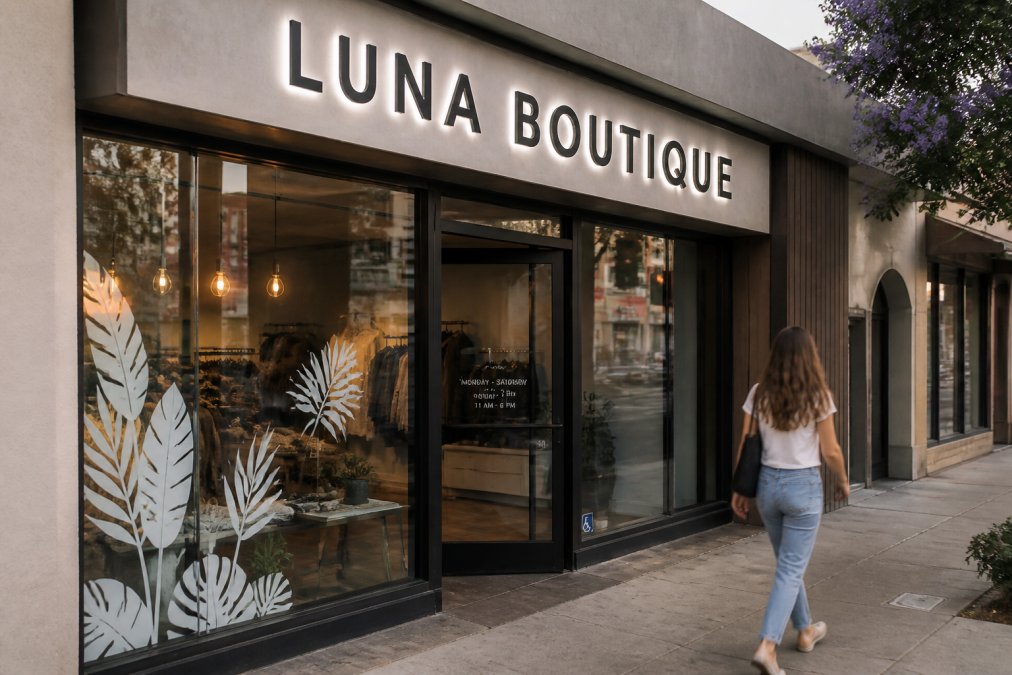
Channel letters are individually fabricated, three-dimensional letters mounted to your facade, often with internal LED lighting. They read clearly from a distance and stay legible at night, which matters on streets where foot traffic peaks after dark. A common mistake is ordering letters sized for a photo rather than the distance a driver or pedestrian actually views them from, measure your sightlines before approving a proof.
Window Graphics, Vinyl Decals, and Wall Murals
Window graphics and vinyl decals turn glass you already pay for into working advertising space. They're the fastest format to install and the easiest to update when your hours or promotions change. Wall murals and dimensional lettering inside the shop extend the same brand identity to customers once they're through the door, and interior work rarely triggers the same permitting requirements as exterior signage.
Retail Sign Permit Requirements in Los Angeles
Retail sign permit requirements in Los Angeles are administered by the Department of Building and Safety (LADBS), with separate design review in some commercial corridors, historic districts, and specific plan areas. The rules for your address depend on your zoning, your sign's dimensions, whether it projects or sits flat, and whether your block carries an overlay that adds a review step.
Step 1: Identify what governs your address
Before you draw anything, pull three things:
- Zoning designation. Sets your permitted sign area as a percentage of storefront frontage, your maximum height, and allowed projection from the facade.
- Overlay districts. Historic preservation overlays, community design overlays, and specific plans each add a review layer on top of base zoning. A sign fully compliant under base zoning can still be denied in an overlay.
- Sign district or supplemental use district. Some corridors have their own sign standards that supersede the general rules.
Look up zoning and overlays through the city's online tools, or call the LADBS counter with your street address, before you commission artwork, not after.
Step 2: Determine which permit you actually need
Small retail shops typically fall into one of three buckets:
- Sign permit only. A flat, wall-mounted sign within your allowed area, no structural or electrical work. The simplest path.
- Sign permit plus electrical permit. Any illuminated sign, channel letters with internal LED, backlit cabinets, or illuminated blade signs, requires an electrical permit and inspection.
- Sign permit plus plan check. Larger signs, projecting signs, signs above a certain height, and signs in historic or design-review districts usually require plan check, where a reviewer examines your drawings before the permit is issued.
Step 3: Prepare drawings that match the fabricated sign
The most common cause of permit delay is a drawing that does not match what gets built. Your submittal package should show:
- Sign dimensions and total square footage
- Letter height and copy
- Mounting method and attachment points
- Illumination type and electrical details, if applicable
- Colors and materials
- A site plan or elevation showing the sign in context on the facade
Step 4: Submit, pay, and schedule inspection
Submit the application with the required drawings and pay the fees, which are calculated on sign type, size, and valuation. After the permit is issued and the sign installed, schedule an inspection; the inspector verifies the sign matches the approved drawings.
Step 5: Landlord approval is not city approval
These are two separate gates, and you need both. Your lease almost always requires landlord or property-manager sign-off on any facade alteration, and that approval has no bearing on whether the city issues a permit. Owners who get one and assume it covers the other end up removing a sign they just paid to install.
Signage Design Best Practices for Maximum Brand Visibility
Signage design best practices come down to legibility at distance, contrast, and restraint. A sign that says everything says nothing.
- Contrast over color preference. A high-contrast sign in a plain palette outperforms a low-contrast sign in your favorite colors.
- One typeface family. Mixing three fonts reads as noise.
- Negative space. Leave breathing room around your name so it stands out from surrounding storefronts.
- Consistency across formats. Your window graphics, interior displays, and vehicle graphics should share the same visual language.
What Drives Custom Storefront Sign Cost
Custom storefront sign cost is driven by materials, size, illumination, installation complexity, and permitting, not a single per-square-foot rate. Two signs of identical dimensions can differ substantially depending on whether they are lit, how high they mount, and whether installation requires a lift or electrical work.
The cost factors, in order of impact
| Cost Factor | What Raises It | What Lowers It |
|---|---|---|
| Material | Aluminum, acrylic, and illuminated assemblies | Vinyl and flat printed panels |
| Illumination | Internal LED channel letters | Non-lit dimensional lettering |
| Size and letter count | More characters, larger footprint | Fewer, larger characters |
| Installation | Lift access, high mounting, electrical tie-in | Ground-level, flat-wall mounting |
| Permitting | Historic or design-review districts | Standard commercial zoning |
Illumination is usually the largest single swing. A non-lit dimensional sign and an internally illuminated LED channel letter sign of the same dimensions sit in very different price brackets, because the lit version adds electrical components, wiring, a power supply, and an electrical permit and inspection.
Why the cheapest quote is rarely the cheapest sign
A low quote often reflects a thinner material gauge, a shorter or absent warranty, or an installer without the right coverage. Normalize quotes on four variables:
- Material specification. Ask for the gauge, the acrylic thickness, and the LED brand and rated life.
- Warranty terms. What is covered, the finish, the LEDs, the power supply, the installation, and for how long.
- Permit handling. Does the quote include permit acquisition and inspection coordination, or is that billed separately?
- Site protection. What happens if the installation damages your facade or awning, and who pays?
Those four answers separate providers faster than price alone.
The return side: how a sign earns its cost back
A storefront sign is a fixed cost that produces impressions every hour you are open. Unlike paid advertising, there is no per-impression charge, no monthly platform fee, and no bidding against competitors for placement, the business case for treating signage as a capital investment rather than an expense.
- Contrast and letter height determine how far away a passerby can read your name, which determines how many people the sign actually reaches.
- Illumination extends your sign's working hours into the evening, when many retail corridors see their heaviest foot traffic.
- Placement, perpendicular blade signs versus flat wall signs, determines whether the sign is visible to people walking along the block, not just those standing directly in front of your door.
How to get a quote you can actually compare
Request itemized quotes rather than a lump sum. An itemized quote shows exactly what you are paying for and lets you compare providers on equal terms. Ask each to break out fabrication, materials, illumination, installation, and permit coordination as separate line items.
How to Choose a Sign Company and Avoid Costly Mistakes
Choosing a sign company is a project-management decision as much as a design one. The right partner handles permitting, fabrication, and installation as one coordinated job, so you're not relaying information between three vendors.
Ask every provider the same five questions:
- Do you handle permit acquisition, or is that on me?
- What's your fabrication timeline from approved proof to installed sign?
- What warranty covers the materials and the installation?
- Can I see examples of work for businesses my size?
- Who is my single point of contact from proof to install?
Frequently Asked Questions
How much does a sign for a small retail shop cost?
Custom storefront sign cost depends on size, materials, lighting, and installation complexity. A simple vinyl window graphic costs far less than a set of illuminated channel letters. Factors like permit fees, electrical work, and whether the sign is illuminated also affect the total. Request quotes from at least two sign companies and ask for a line-item breakdown so you can compare fairly. GBCJ Los Angeles provides free quotes based on your specific storefront.
What are the retail sign permit requirements in Los Angeles?
Most permanent storefront signs require a permit from the Los Angeles Department of Building and Safety. You will typically need a site plan, sign drawings to scale, structural calculations for larger signs, and landlord approval if you lease. Signs in historic districts or specific corridors may face additional design review. Start the permit process well in advance of your target installation date to avoid delays.
What are the most effective types of retail shop signs?
Illuminated channel letters and cabinet signs perform best for street-facing visibility because they stay readable at night. Window graphics and vinyl decals work well for promotions and seasonal messaging at a lower cost. Many small retailers combine two or three types: a permanent illuminated sign for brand identity, plus window graphics that change with promotions.
How do I choose a professional sign company for my business?
Look for a company that handles design, permitting, fabrication, and installation in-house. Ask to see photos of completed retail projects, confirm they carry liability insurance, and get the warranty terms in writing. A good sign company will visit your location before quoting, explain the permit process clearly, and give you a realistic timeline. Avoid providers who quote without seeing your storefront or who cannot explain who pulls the permit.