 blog
blog
Affordable Custom Signage for Small Offices in 2026
Table of Contents
- Why Affordable Custom Signage Matters for Small Offices
- Types of Custom Office Signs and Where to Use Them
- Best Materials for Indoor Business Signs
- Cost-Effective Lobby Sign Ideas
- ADA Compliant Office Signs: What You Need to Know
- DIY vs. Professional Installation: Which Saves You More?
- How to Make Your Affordable Custom Signage Last
- Frequently Asked Questions
Last Updated: September 15, 2026
Why Affordable Custom Signage Matters for Small Offices
Affordable custom signage is professionally produced visual communication that fits a small office budget without sacrificing a finished, on-brand look. It's often a visitor's first physical touchpoint with the brand, making it a marketing asset rather than a decoration line item.
At GBCJ Los Angeles, we've spent over 15 years in the graphics and sign industry, and we've observed that offices that treat signage as part of their visual identity often achieve better results than those that prioritize only the lowest cost. A reception sign, door plates, and directional markers orient people, reinforce the brand, and signal an established business.
Below, we'll break down the sign types worth buying, the materials that hold up indoors, and where you can save without it showing, plus ADA compliance and the math behind DIY versus professional installation.
Types of Custom Office Signs and Where to Use Them
Office signage divides into three groups: reception and lobby signs, wayfinding and directional signs, and door and room identification signs, each with a different job, durability requirement, and cost profile.
Reception and Lobby Signs
The lobby sign anchors your visual identity indoors: a dimensional logo, often acrylic, brushed metal, or PVC board mounted behind the reception desk. Visitors read it at close range, so logo reproduction quality matters most, a crisp graphic reads as professional, while visible pixelation reads as temporary. Spend here first.
Wayfinding and Directional Signs
Wayfinding signage tells people where to go without a staff escort, usually wall-mounted directional panels, a restroom marker, and an exit path. The goal is fewer interruptions at the front desk, and consistency in typeface, color, and mounting height makes signs readable at a glance.
Door and Room Identification Signs
Door and room signs identify individual spaces: conference rooms, private offices, storage, and utility closets. These are the highest-count, lowest-unit-cost items in the package, and an office directory board near the entrance does the same work for the whole floor. Because you're ordering many, door signs are where bulk pricing and standard sizing save real money.
| Sign Type | Typical Placement | Material Fit | Priority |
|---|---|---|---|
| Reception/lobby | Behind front desk | Acrylic, brushed metal, PVC board | First |
| Wayfinding | Corridors, stairwells | PVC board, vinyl, wall decals | Second |
| Door/room ID | Each office door | Acrylic, PVC, vinyl | Third |
| Directory | Lobby entrance | PVC board, Dibond | Optional |
Best Materials for Indoor Business Signs
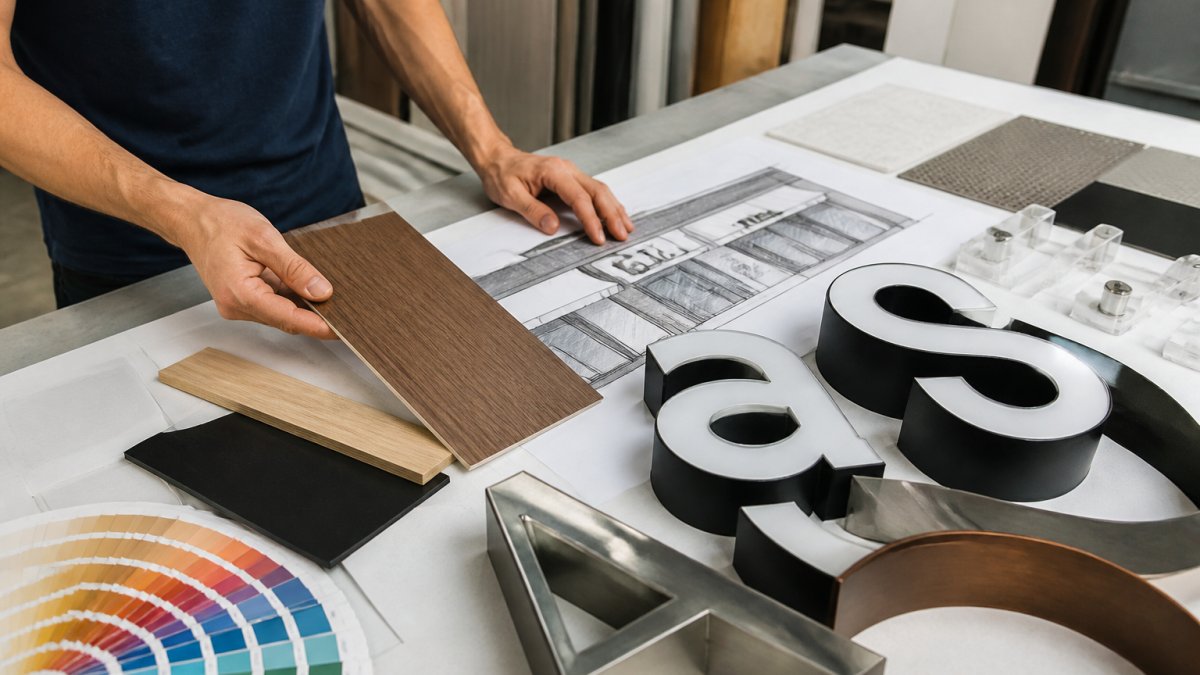
The best materials for indoor business signs are acrylic, PVC board, Dibond, and vinyl, chosen by how much foot traffic and handling the sign will see. Indoor signs don't face UV or rain, so spend less on weatherproofing and more on finish quality.
Here's how the common options compare in practice:
- Acrylic: The standard for dimensional lobby logos. Clean edges, good depth, holds up for years indoors. Costs more per square foot than flat alternatives.
- PVC board: Lightweight, easy to mount, and the workhorse for door signs and directory panels. It's not as rigid as acrylic, so it can bow on very large panels.
- Dibond: Two thin aluminum sheets over a core. Flat, rigid, and the right call for large wall graphics that must stay perfectly straight.
- Vinyl and wall decals: The cheapest way to cover a large wall with full-color printing. Great for brand walls and temporary campaigns; less forgiving if the wall surface isn't smooth.
- Corrugated plastic: Fine for short-term indoor displays, not for anything you want to look permanent.
A common mistake is ordering acrylic for every sign. Door plates don't always need dimensional depth, and PVC or vinyl can be suitable alternatives. Match material to viewing distance and lifespan.
Cost-Effective Lobby Sign Ideas
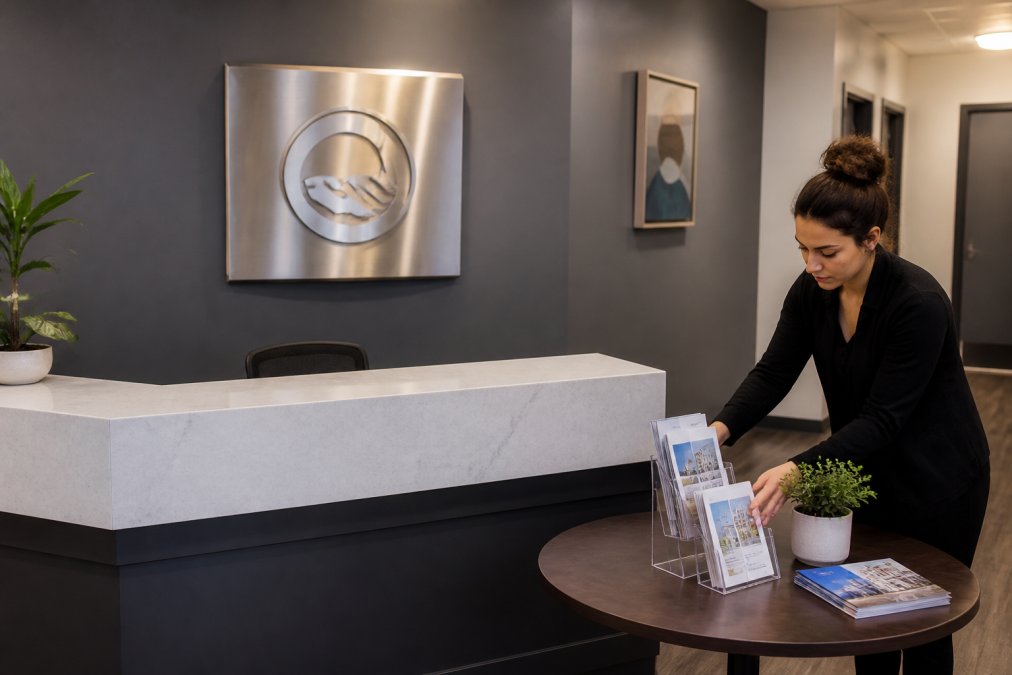
The most cost-effective lobby sign ideas use one high-impact focal piece plus inexpensive supporting elements, rather than spending evenly across every wall. One well-made dimensional logo behind reception carries more brand weight than five mediocre signs.
Approaches that keep costs down without looking cheap:
- Go dimensional on one wall only. Put the budget into the reception logo, then use flat vinyl or PVC for everything else.
- Use a brand wall instead of framed art. Full-color printing on vinyl covers a large area for less than multiple framed pieces.
- Standardize door sign sizing. One size, one material, one order. Custom dimensions on every door plate is where budgets quietly disappear.
- Reuse your design template. Once the logo and type system are set, every additional sign is a variation, not a new design project.
- Order in one batch. Bulk pricing and a single production run almost always beat ordering signs piecemeal over several months.
ADA Compliant Office Signs: What You Need to Know
ADA compliant office signs are permanent room signs that meet the accessibility standards in the Americans with Disabilities Act, which governs signage in places of public accommodation. The requirements cover raised characters, Braille, non-glare finish, and mounting height and location, and apply to permanent room identification signs, not your lobby logo.
This is the section most small-office guides skip, and it's the one that creates real liability. If your office is open to the public or houses employees, permanent room signs for restrooms, exits, and accessible spaces generally need to comply, and the specifics are more granular than most buyers expect.
What the Standard Actually Requires
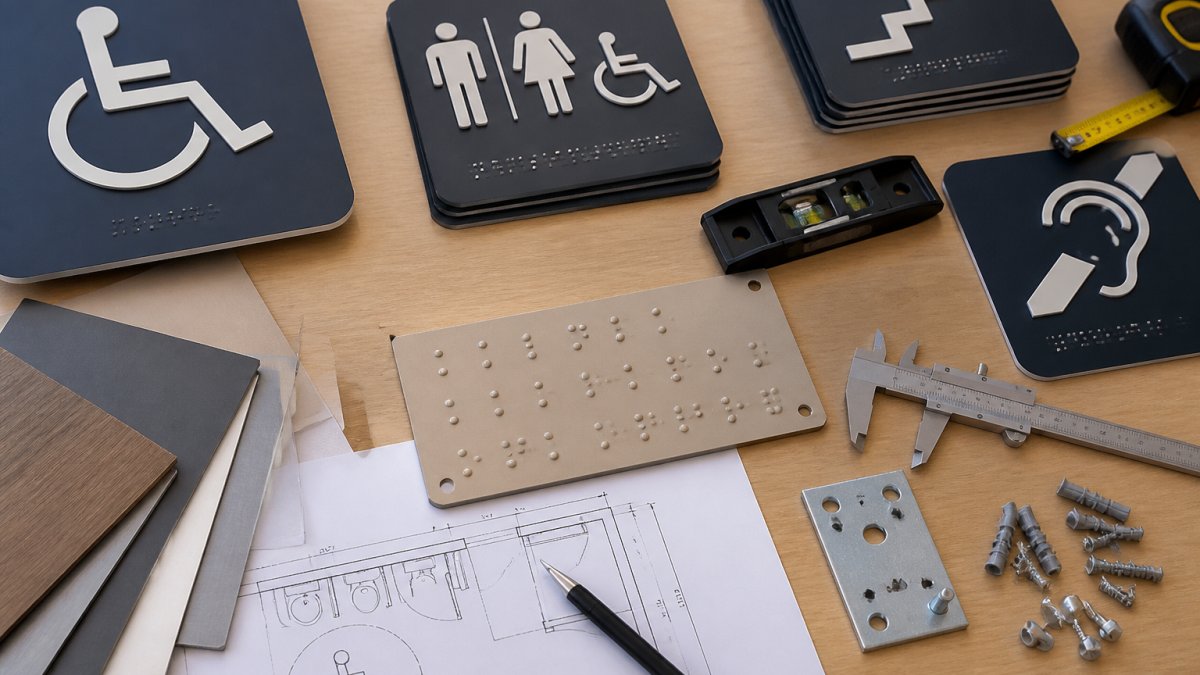
The ADA Standards for Accessible Design set measurable criteria for permanent room identification signs, including:
- Raised characters: A minimum height of 5/8 inch and a maximum of 2 inches, with a stroke width between 1/8 and 1/4 inch, and a character style that is sans serif and not italic, oblique, script, or highly decorative.
- Braille: Grade 2 Braille is required, positioned directly below the corresponding text, with specific dome spacing and a minimum dot height.
- Finish: A non-glare finish is required, with characters and background in contrasting light-on-dark or dark-on-light combinations.
- Mounting height: Tactile signs are typically mounted with the baseline of the lowest raised character between 48 and 60 inches above the finished floor, on the latch side of the door (Chapter 7: Signs).
- Pictograms: Where a pictogram is used, it must be in a field at least 6 inches high, with the text descriptor placed directly below it.
These numbers are the difference between a sign that passes inspection and one that has to be remade. A sign that looks fine at a glance can still fail on character height, stroke width, or Braille placement.
Which Signs Need to Comply
Not every sign falls under the standard. The distinction is between permanent room identification and everything else:
- Covered: Restroom signs, room identification signs for offices and conference rooms, exit signs, and any permanent sign identifying a space or feature.
- Not covered: Your lobby logo, decorative wall graphics, temporary campaign signage, and directional signs that are not identifying a permanent room.
The trap is that the line isn't always obvious: a sign that identifies a room and is mounted permanently is generally covered even if it's small and inexpensive, while a decorative sign near a door generally is not.
How to Handle Compliance Without Guessing
The practical move is to confirm the current requirements directly with the ADA Standards for Accessible Design before you order, and to tell your sign fabricator which signs need to be compliant. A reputable shop will build compliance into the proof rather than treating it as an afterthought.
A Practical Checklist Before You Order
DIY vs. Professional Installation: Which Saves You More?
Consider these points:
How to Make Your Affordable Custom Signage Last
Realistic Lifespans by Material
Cleaning Chemistry That Protects the Sign
The ROI Math Behind Maintenance
Frequently Asked Questions
How much do affordable custom signs typically cost?
Pricing depends on size, material, quantity, and installation. For a small office, simple vinyl or acrylic signs cost less than custom illuminated or dimensional letters. Request quotes from local providers to compare. GBCJ Los Angeles offers competitive pricing for small businesses; contact them for a personalized quote based on your specific needs.
What materials are best for affordable indoor office signage?
For indoor use, PVC board and acrylic are durable and budget-friendly. Corrugated plastic works for temporary signs, while dibond (aluminum composite) offers a professional finish for permanent displays. Vinyl decals are cost-effective for wall graphics. Consider your office aesthetic and how long you need the sign to last when choosing.
What are the ADA requirements for small office signage?
The ADA requires permanent room signs to have raised characters and Braille, with specific contrast and mounting height (48 to 60 inches to baseline). Signs must be on the latch side of doors. Temporary signs are exempt. For a small office, focus on restrooms, exits, and room numbers. Consult a professional sign maker to ensure compliance.
Is it better to buy pre-made or custom signs for a small office?
Pre-made signs are cheaper and faster but lack branding. Custom signs reinforce your visual identity and can be designed to fit your space. For a professional look that impresses clients, custom signage is worth the investment. Many providers offer design templates and no order minimums, making custom options accessible for small offices.